← Otto Developer GuideThe Vulkan Renderer
Otto draws with Skia. On the udev backend (a real session on a TTY) Skia can run on either of two GPU APIs:
- OpenGL ES, through EGL. This is
SkiaRendererincrates/otto-render/src/skia_renderer.rs, the fallback, and the only choice on winit and x11. - Vulkan. This is
SkiaVkRendererincrates/otto-render/src/renderer/vulkan/, the default on the udev backend.
Everything above the renderer is shared: the lay-rs scene graph, the render
elements, damage tracking, Smithay’s DrmCompositor. The Vulkan renderer only
changes how client buffers get into Skia, where Skia draws, and how the rest of
the system learns that a frame is done. If you know Rendering,
this page is the part below “Skia draws”.
For the reasoning behind the port, the phase plan and what the probe found, see Vulkan Renderer Plan.
Why Vulkan at all
- Explicit sync. A finished frame is a sync file that goes straight to
KMS. The GL path needs an EGL fence, a
glFlush, and in places a CPU wait, because Mesa attaches no implicit fence to EGLImage render targets. - One import path. A client dmabuf becomes a
VkImagewith its exact DRM format modifier. No EGLImage, no external-texture fallback, nowl_drm. - Formats. 10-bit and fp16 render targets are ordinary Vulkan formats; the HDR work needs them.
Choosing the renderer
Vulkan is the default. To draw with OpenGL instead:
otto --tty-udev --renderer gl # one session
or, to keep it:
[rendering]
renderer = "gl"   # "vulkan" is the default
Settings › General › Renderer writes the same key. The command line wins over
the config. The vulkan Cargo feature is in the default feature set; a build
without it defaults to OpenGL, and refuses an explicit --renderer vulkan with
an error naming the feature.
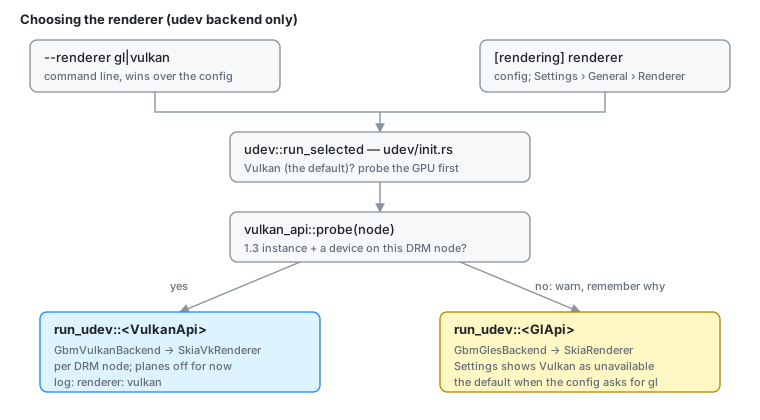
Before committing to Vulkan, udev::run_selected (src/udev/init.rs) probes
the primary GPU with renderer::vulkan_api::probe: it needs a Vulkan 1.3
instance and a physical device whose render or primary node is that GPU. When
the probe fails (no loader, no ICD, an old driver, a VM GPU) the session logs
why on otto::udev and runs on GL instead, recording the reason with
renderer::vulkan_api::set_vulkan_fallback, and Settings shows Vulkan as
unavailable.
This matters because a stored renderer = "vulkan" that simply exited would
leave the user stuck at the greeter.
Startup logs one line naming the device, driver, render node, Vulkan version, format counts and whether sync files can be exported and imported:
Rendering with Skia on Vulkan: <device> (<driver>), render node <path>, Vulkan <version>, ...
How the udev backend holds two renderers
The udev backend is generic over a RendererApi (crates/otto-render/src/renderer/active.rs).
UdevData<A> and every impl Otto<UdevData<A>> are compiled once per
renderer, and main picks which one runs. There is no runtime dispatch in the
render loop and no mixed mode: one session, one renderer.
GlApi | VulkanApi | |
|---|---|---|
| Smithay multi-GPU api | GbmGlesBackend | GbmVulkanBackend (crates/otto-render/src/renderer/vulkan_api.rs) |
| Device renderer | SkiaRenderer | SkiaVkRenderer |
PLANES_SUPPORTED | true | false (see What is missing) |
wl_drm | offered | not offered; clients use linux-dmabuf |
What the backend needs beyond Smithay’s traits (plane surfaces, render
formats, the Skia context, flushing planes) goes through the small
SkiaDeviceRenderer trait, which both renderers implement.
The drawing code exists once. Render elements draw into whatever frame they
get through FrameSurface, and both SkiaFrame and SkiaVkFrame call the
same helpers in crates/otto-render/src/renderer/draw.rs. A visual change to an element never
needs a Vulkan-specific twin.
GbmVulkanBackend plays the part GbmGlesBackend plays for GL: one
SkiaVkRenderer per DRM node, next to a GBM allocator for that node. The
renderer is created when the node is added, so a GPU Vulkan cannot drive fails
there with a named error rather than on the first frame.
Inside SkiaVkRenderer
| File | What it holds |
|---|---|
mod.rs | The renderer, its Smithay trait impls, imports, targets, blits |
frame.rs | SkiaVkFrame, the per-frame drawing handle |
sync.rs | Sync files around Skia’s submits, the semaphore pool |
texture.rs | SkiaVkTexture, SkiaVkTarget, read-back mappings |
retire.rs | Deferred destruction of GPU memory Skia may still read |
format.rs | The DRM fourcc ↔ Vulkan ↔ Skia colour-type table |
tests.rs | GPU tests, ignored unless asked for |
Setting up
SkiaVkRenderer::new checks the physical device for six extensions (external
memory fd, dma-buf, DRM format modifiers, external semaphore fd, foreign queue
family, image format list), creates a Smithay Vulkan Device on the
graphics queue, and builds a Skia Ganesh DirectContext on that device and
queue. When the device supports samplerYcbcrConversion it is enabled, so YUV
video buffers can be sampled.
The context is built in context.rs through the raw skia-bindings
(layers::sb), not skia-safe’s BackendContext: Skia only samples YUV when
fDeviceFeatures2 tells it the YCbCr feature is on, and skia-safe has no way
to set that field. context.rs writes it at its offset in
skgpu::VulkanBackendContext, with a compile-time check on the struct size,
so a skia-safe upgrade that changes the layout fails the build instead of
misreading features.
Skia is told the API version explicitly, capped at 1.3. A driver may report 1.4 while the instance is 1.3; without the cap Skia asks for 1.4 entry points the loader never hands out, and context creation fails without saying why.
The renderer then works out which formats it can sample (dmabuf_formats)
and which it can render into (render_formats), keeping only fourccs that
format.rs can map to Skia. Each alpha format also offers its X twin
(XRGB8888 for ARGB8888), since Vulkan lists only the alpha one and
XWayland’s depth-24 windows need the opaque one.
NV12 is sample-only. It imports with SAMPLED usage alone and is wrapped
with a YcbcrConversionInfo, so Skia converts to RGB as it samples: BT.601
up to 576 lines and BT.709 above, limited range, chroma at the midpoint,
filtered linearly where the modifier’s format features allow. Clients have
no way to say how their YUV is encoded yet, so the size decides, as video
players do for untagged video.
Buffers in a frame
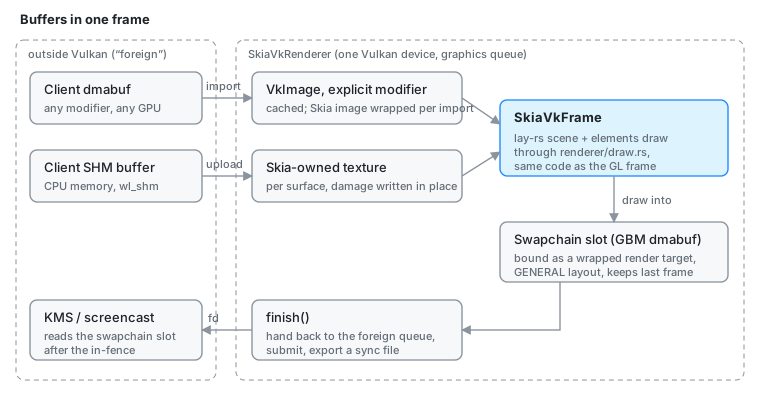
Client dmabufs import with VulkanImage::new_from_dmabuf, using the
buffer’s explicit modifier. The VkImage is cached per buffer (keyed weakly,
so the cache never keeps a dead buffer alive), but the Skia image around it is
made fresh on every import. A re-import follows a client commit, after which
the buffer belongs to the client again and Skia must not trust the layout it
saw last time.
SHM buffers (and import_memory, used for the cursor) upload into a
Skia-owned GPU texture. Each surface keeps its texture, so later commits only
write their damaged rectangles.
Render targets are dmabufs too: the swapchain slots Smithay’s
DrmCompositor allocates with GBM. Bind<Dmabuf> wraps one as a Skia render
target in GENERAL layout and caches the wrapper. GENERAL rather than
UNDEFINED matters: a slot has to keep its last frame’s pixels, or partial
damage would repaint on top of garbage.
Offscreen targets (Offscreen::create_buffer) are plain Skia render
targets that Skia allocates itself.
Handing a buffer back
Vulkan tracks who owns an image. The renderer uses QUEUE_FAMILY_FOREIGN_EXT
for “someone outside this Vulkan device”: KMS, a client, another GPU. Before
Skia can touch a dmabuf it has to acquire it from the foreign family; when
it is done it has to release it back.
Skia does the acquire itself, because every wrapped image is described to it
as foreign-owned in GENERAL layout. The release happens in
flush_target: dmabuf targets are flushed with
flush_surface_with_texture_state(GENERAL, QUEUE_FAMILY_FOREIGN_EXT), so
after every frame, read-back or blit the buffer is back where KMS and other
devices expect it. Forgetting this step shows up as garbage or stale content
on screen, because Skia’s layout transitions and the scanout engine disagree.
Sampled client dmabufs are released too. Each import records the texture’s
BackendTexture in sampled, and release_sampled runs between the flush
and the submit of every frame: set_backend_texture_state(GENERAL, QUEUE_FAMILY_FOREIGN_EXT) on each live one. Skia skips images already in
that state, so only the textures drawn this frame get a barrier, and the
next draw acquires them again.
Sync
skia-safe exposes no semaphore API: there is no way to hand Skia a semaphore to wait on or signal. The renderer works around Skia instead of inside it, with its own submits placed right before or right after Skia’s.
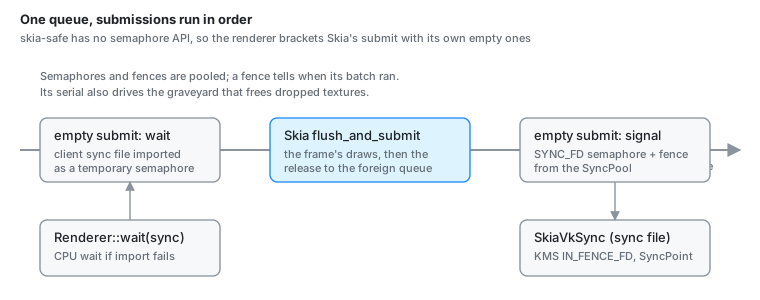
- Finishing a frame.
SkiaVkFrame::finishcallssubmit_target: flush and release the target,flush_and_submit, thenSyncPool::signalsubmits an empty batch that signals a semaphore exportable as aSYNC_FD. The exported file is aSkiaVkSync, which is a SmithayFence; it goes to KMS as the plane’sIN_FENCE_FDand anywhere else that takes aSyncPoint. - Waiting for a client.
Renderer::waitexports the client’s sync point as a sync file, imports it as a temporary semaphore payload, and submits a batch that waits on it. A semaphore wait only holds back its own batch, so that batch also runs one pre-recorded command buffer with a fullALL_COMMANDSpipeline barrier. A barrier’s second scope is every command later in submission order on the queue, so Skia’s next submits wait for the client through it. If the import or submit fails, the wait falls back to the CPU. - Drivers without
SYNC_FDexport.signalblocks onvkQueueWaitIdleand returns an already-signalled point. Slow, but correct. - Screenshare copies.
blit_current_frameattaches the copy’s sync file to the destination dmabuf as an implicit write fence (DMA_BUF_IOCTL_IMPORT_SYNC_FILE), so a PipeWire consumer that relies on implicit sync waits for the GPU. On kernels without the ioctl it waits on the CPU instead.
Semaphores and fences are pooled in SyncPool. A semaphore can only be reused
once its batch has run, which the fence submitted alongside it tells. Every
signal also gets a serial number, and completed() reports the last serial
the GPU has finished; the next section uses that.
Freeing memory safely
Skia wraps dmabuf images it does not own, so it cannot keep them alive, and the Skia image of a texture escapes the renderer: lay-rs holds it to draw the window, and recorded pictures reference it. A texture can be dropped by Smithay while a picture still points at it, or while the GPU has not yet run the frame that samples it.
So memory is never freed on drop. TextureBacking and dead render targets
hand their memory to the renderer’s graveyard (retire.rs) together with
the Skia handle that reads it. On each submit, Graveyard::reap:
- marks an entry once nothing but the graveyard holds its Skia handle, stamping it with the serial of the frame just submitted;
- destroys the entry once the GPU has completed that serial.
Plane slot images go through a similar queue (PlaneTextureRelease), drained
in flush_planes_for_scanout after a CPU sync.
Copies and read-back
| Smithay trait | How |
|---|---|
ExportMem (screencopy, screenshots) | Surface::read_pixels, then release the target again |
Blit | snapshot of the source, drawn into the destination with BlendMode::Src |
BlitCurrentFrame (screenshare) | the same copy from the last bound target, fenced into the destination dmabuf |
Testing
The GPU tests in crates/otto-render/src/renderer/vulkan/tests.rs need a real Vulkan device, so
they are #[ignore]d and CI skips them:
cargo test --features vulkan --lib -- --ignored vulkan
They cover offscreen draw and read-back, a GBM dmabuf rendered and imported
back, the X formats drawing opaque, an image-cached lay-rs mirror of a
texture, a whole layer tree over an XRGB dmabuf, and plane surfaces sampling
dmabuf textures.
On a live session, check the startup line on otto::udev (renderer: vulkan) and the device line above. If the log instead says Vulkan was
requested but unavailable, the probe failed and the session is on GL.
What is missing
- Plane scanout.
VulkanApi::PLANES_SUPPORTEDisfalse, so every output composites into the primary plane: no dock, popup or fullscreen window on its own KMS plane yet. The plane code builds for Vulkan (create_surface_from_dmabuf,flush_planes_for_scanout) but has not been run on hardware. See DRM Planes. - More YUV. NV12 is the only YUV format. P010 and other layouts need
entries in
format.rs. NV12 with its planes in separate buffer objects (disjoint) is refused by Smithay’s device layer, which needsVkBindImagePlaneMemoryInfo. Single-object NV12, which VAAPI exports, works. The encoding is guessed from the height (BT.601 for SD, BT.709 for HD) until clients can describe it. - Texture filters and debug flags are stored and ignored, as on GL.
- Driver coverage. Tested on Intel (ANV). NVK and the proprietary NVIDIA
driver still need checking for
SYNC_FDexport and modifier imports. - winit and x11 stay on GL in every build.
Where to look
| Question | File |
|---|---|
| How is the renderer picked, and when does it fall back? | src/udev/init.rs (run_selected), src/main.rs |
| What does the backend require of a renderer? | crates/otto-render/src/renderer/active.rs |
| How are renderers created per GPU? | crates/otto-render/src/renderer/vulkan_api.rs |
| Why is my buffer refused? | crates/otto-render/src/renderer/vulkan/format.rs, then the cannot render into dmabuf warning in mod.rs |
| Why is a frame not fenced? | crates/otto-render/src/renderer/vulkan/sync.rs |
| Why is a texture still alive? | crates/otto-render/src/renderer/vulkan/retire.rs |