← Otto Developer GuideScreen Sharing
How frames get out of Otto and into Chrome, OBS, grim or wf-recorder.
The shape of it
There are two halves that never touch each other, and most confusion about this subsystem comes from conflating them:
- Control plane: D-Bus. Who is allowed to capture what. Creating sessions, picking a source, starting and stopping streams.
- Data plane: GPU. Once a stream exists, frames are blitted from the compositor’s framebuffer into a PipeWire buffer with no CPU involvement at all.
The control plane is four processes deep, because that is what the portal
standard requires: an app must not be able to start capturing without a
trusted intermediary asking the user first. The data plane is one glBlit.
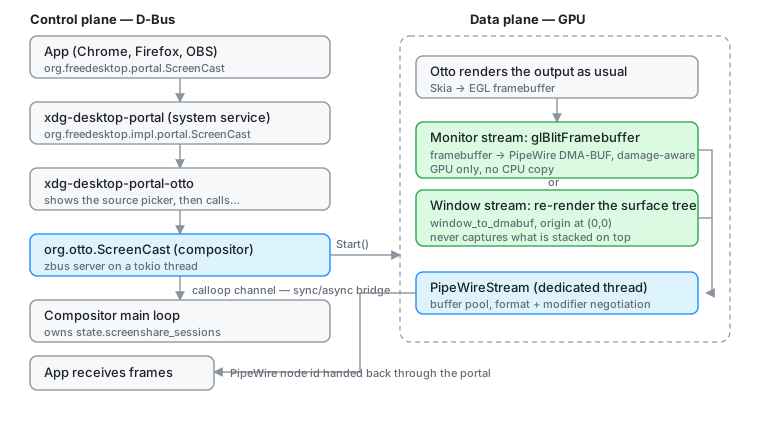
Two independent capture APIs exist on top of this:
| API | Used by | Path |
|---|---|---|
org.freedesktop.portal.ScreenCast | Chrome, Firefox, OBS, GNOME recorder | portal → org.otto.ScreenCast → PipeWire |
zwlr_screencopy_manager_v1 | grim, wf-recorder, wl-mirror, wlrobs | Wayland protocol, direct to the compositor |
They share the same GPU blit. See wlr-screencopy below.
Only the udev backend delivers frames. winit starts the D-Bus service but implements no per-frame delivery, so screenshare cannot be developed in windowed mode.
Control plane
1. The D-Bus service: src/screenshare/dbus_service.rs
The compositor runs a zbus server on a dedicated tokio thread:
| Interface | Path |
|---|---|
org.otto.ScreenCast | /org/otto/ScreenCast |
org.otto.ScreenCast.Session | /org/otto/ScreenCast/session/<id> |
org.otto.ScreenCast.Stream | <session>/stream/<id> |
org.otto.ScreenCast
  CreateSession(properties: a{sv}) -> session_path: o
  ListOutputs()                    -> connectors: as
  ListWindows()                    -> windows: a(sss)     # (identifier, app_id, title)

org.otto.ScreenCast.Session
  RecordMonitor(connector: s, properties: a{sv}) -> stream_path: o
  RecordWindow(properties: a{sv})                -> stream_path: o
  Start()
  Stop()
  OpenPipeWireRemote(options: a{sv})             -> fd: h

org.otto.ScreenCast.Stream
  Start()
  Stop()
  PipeWireNode() -> info: a{sv}
  Metadata()     -> info: a{sv}    # connector|window-id, source-type, size, cursor-mode
Start() is where the compositor actually creates the PipeWire stream; the
node id comes back through PipeWireNode().
RecordWindow’s window-id is an ext-foreign-toplevel-list-v1 identifier,
exactly as returned by ListWindows. See
foreign-toplevel.md.
OpenPipeWireRemote is wired end to end but the compositor side
(GetPipeWireFd) still returns an error: it is a TODO in
src/screenshare/mod.rs. In practice apps connect to the PipeWire daemon
themselves and use the node id, so this has not blocked anything.
2. The sync/async bridge: src/screenshare/mod.rs
The compositor loop is synchronous (calloop); zbus is async. The bridge is a
calloop::channel: the D-Bus thread sends a CompositorCommand, and the main
loop handles it and mutates state.screenshare_sessions.
This is the first place to look when a D-Bus call appears to hang or do nothing: nearly always the calloop side never received or handled the command.
CompositorCommand also carries non-screenshare traffic (FocusApp,
SetSetting, ResetSetting), because it is the compositor’s general
“something off-thread wants the main loop” channel.
A stream targets one of two things:
pub enum StreamTarget {
    Output(String),   // connector name, e.g. "HDMI-A-1"
    Window(String),   // ext-foreign-toplevel-list-v1 identifier
}
which is also the key into ScreencastSession::streams, as
output:<connector> or window:<identifier>.
3. PipeWire: src/screenshare/pipewire_stream.rs
PipeWireStream owns the stream and its buffer pool, running a PipeWire main
loop on its own thread. It negotiates a video format, asks for DMA-BUF
buffers, configures single-buffer mode (min=1,max=1), and advertises
SPA_META_VideoDamage so consumers can use damage metadata.
pub struct StreamConfig {
    pub width: u32,
    pub height: u32,
    pub framerate_num: u32,
    pub framerate_denom: u32,
    pub gbm_device: Option<Arc<GbmDevice<DrmDeviceFd>>>,
    pub capabilities: BackendCapabilities,
}
Data plane
Monitor capture: blit the framebuffer
- Otto renders the output as usual (Skia → GL framebuffer).
- If a stream exists for that output, it dequeues an available PipeWire buffer.
- It blits the framebuffer into that DMA-BUF with
BlitCurrentFrame::blit_current_frame, a plainglBlitFramebuffer. - It tells PipeWire to queue the buffer.
No CPU copy, no second render. Damage is forwarded where possible; the first
frame, or a buffer change, forces a full-frame blit. This lives in
render_surface(...) in src/udev/render.rs, gated on
outcome.rendered && !screenshare_sessions.is_empty().
Window capture: re-render the window
Window streams do not blit the composited framebuffer. They re-render the
window’s own surface tree — toplevel, subsurfaces and popups — into the
PipeWire dmabuf via window_to_dmabuf, with the window’s geometry origin at
(0, 0).
That choice has consequences worth knowing:
- Nothing stacked above the shared window can leak into the capture.
- The window keeps streaming while occluded, on another workspace, or minimized.
lay-rsscene decoration (shadows, rounded corners, blur) is not in the capture. This is the client’s raw content.- The size is fixed at
RecordWindowtime (even-rounded physical pixels) and then tracks the window:PipeWireStream::request_sizeis called every frame with the current size, and the PipeWire thread renegotiates the format after a 250 ms debounce. The window is cropped or letterboxed only for the few frames until new buffers arrive.
Two supporting mechanisms make this work:
- Frame pacing.
WindowThrottleState::Captured(src/state/window_throttle.rs) pins a captured window to full-rate frame callbacks, outranking minimize and occlusion, without marking itactivated. Without this a shared background window would tick at 2 Hz. See render_loop.md. - Render triggers.
screencast_activeandkick_screencast_outputsinsrc/udev/render.rsresolve a window target to the output currently hosting it, so that output forces a composite and keeps painting while idle.
Both call crate::screenshare::window_for_identifier, which takes
&Workspaces and &foreign_toplevels separately rather than &Otto: the
render loop already holds a mutable borrow of backend_data, so only
field-disjoint borrows compile there.
wlr-screencopy-v1
The portal is not the only way out. grim, wf-recorder, wl-mirror and OBS
via wlrobs speak zwlr_screencopy_manager_v1 directly, implemented in
src/state/screencopy.rs.
To avoid two parallel readback paths, it reuses the same BlitCurrentFrame
infrastructure:
- Otto advertises
linux_dmabufalongside the SHMbufferevent for v3+ clients, so capable consumers negotiate a GPU dmabuf and skip CPU readback. - Dmabuf clients ride
BlitCurrentFrame::blit_current_frame, the very sameglBlitFramebufferPipeWire screenshare uses. Zero CPU copy. - SHM clients (legacy
grim,wf-recorderby default) fall back toskia_surface.read_pixels: synchronous and expensive, but paid only by the tools that need it. Replacing it with a blit-into-temp-dmabuf plus async PBO readback would bring it to parity. - The post-render hook is gated on
!pending_screencopy_frames.is_empty(), so it costs nothing when nobody is asking. It does not force renders: pending frames piggyback on the next frame that happens for some other reason (scene damage, cursor, DnD).
Measured on Iris Xe, 2880×1920 @ 120 Hz, idle desktop at ~7% Otto CPU:
| Capture | Otto CPU |
|---|---|
| none | 7% |
wf-recorder -c h264_vaapi (dmabuf) | ~9% |
wf-recorder default (SHM, libx264) | ~30% |
DMA-BUF modifier negotiation
This is the subtlest part of the subsystem, and the source of the “corrupted/mangled frames” class of bug.
build_format_params (src/screenshare/pipewire_stream.rs) advertises
Argb8888 as one EnumFormat pod per modifier: LINEAR first, then every
EGL-reported modifier that survives a real GBM allocation test and comes back
single-plane (Intel CCS aux-plane modifiers are excluded). Each pod fixes its
modifier as a MANDATORY Long, rather than offering a single DONT_FIXATE
choice pod.
That shape is required because gst-plugin-pipewire ≥ 1.2 only negotiates
dmabuf through explicit DMA_DRM caps, and Intel’s vapostproc importer only
lists Y-tiled RGB formats: a LINEAR-only offer fails with “no more input
formats”.
On the consuming side, parse_negotiated_format reads a fixed Long modifier
directly, or the default (first) value of a Choice pod. An unreadable
modifier is a hard error, never a silent fallback to LINEAR: falling back
would read tiled buffers as linear, i.e. visibly scrambled frames.
SHM pods are only built when the backend reports no DMA-BUF modifiers at all; they are never offered alongside the DMA-BUF pods. So on a normal GPU session a non-DMA_DRM GStreamer pipeline cannot negotiate.
Full rationale: specs/screenshare.md.
Source selection and restore
SelectSources in
components/xdg-desktop-portal-otto/src/portal/interface.rs presents a single
radio list combining every output and every window, rendered by otto-islands
through the org.otto.Dialog1 service, the same dialog the portal’s Access
implementation uses. Option ids are monitor:<connector> and
window:<identifier>.
If no dialog renderer answers on the bus, SelectSources is refused
(response 2): nothing is picked on the user’s behalf.
Restore. An approved source survives into a new session through the spec’s
restore_data handshake
(components/xdg-desktop-portal-otto/src/portal/restore.rs): Start returns
("otto", 1, {source-type, id}), the frontend hands the app a token, and a
SelectSources that replays the tuple skips the picker as long as the source
still exists and still matches the requested types.
Chrome depends on this. Its window picker builds the preview in one session and then re-creates the session for the real capture, so without a restorable token the dialog would open a second time on top of a live share.
Two things gate this and are easy to break:
- The impl interface must export
versionunder exactly that lowercase name (#[zbus(property, name = "version")]). zbus would otherwise deriveVersion, xdg-desktop-portal reads 0, and everything added after interface version 1 is silently gated off, includingAvailableCursorModesand therestore_dataround-trip. AvailableSourceTypesmust include theWINDOWbit.
Testing a portal build
The backend’s bus name is user-wide, and the session bus outlives the
graphical session. A backend from an earlier login keeps
org.freedesktop.impl.portal.desktop.otto until it is killed.
The backend claims the name with ReplaceExisting | AllowReplacement and exits
when a newer instance takes over, so starting the new build is usually enough.
A backend that refuses replacement has to be killed by hand; the new one exits
with a message saying so.
Running it
Starting the compositor
Production (TTY):
./scripts/start_session.sh
which creates or reuses a D-Bus session, saves it to
$XDG_RUNTIME_DIR/dbus-session for other terminals, starts/verifies PipeWire
via systemctl, launches xdg-desktop-portal-otto, and starts the compositor
with the right environment.
You need PipeWire and a session manager (usually WirePlumber) running.
Running apps
From another terminal on the same TTY:
source "$XDG_RUNTIME_DIR/dbus-session"
export WAYLAND_DISPLAY=wayland-0
google-chrome   # or firefox, obs, …
If an app cannot see screensharing, it is almost always a D-Bus session mismatch.
Expect ~60 FPS: the stream framerate is capped at 60 regardless of the
display’s refresh rate. Chrome and most WebRTC implementations refuse PipeWire
streams above that and fail format negotiation with “no more input formats”, so
a 120 Hz display would otherwise break screensharing entirely. The cap should
become configurable (config.screenshare.max_fps) for clients that can go
higher.
Sanity checks
busctl --user list | grep org.otto.ScreenCast
busctl --user introspect org.otto.ScreenCast /org/otto/ScreenCast
pw-dump   # then find the node id the portal returned
Troubleshooting
No outputs in the share dialog: the app is in a different D-Bus session.
Check echo $DBUS_SESSION_BUS_ADDRESS, verify the portal is registered
(busctl --user list | grep otto), and source "$XDG_RUNTIME_DIR/dbus-session"
before launching.
Video freezes after a few seconds: check PipeWire is alive
(pgrep -x pipewire), read otto.log, and make sure the user services are
enabled:
systemctl --user enable --now pipewire.service pipewire-pulse.service wireplumber.service
Portal backend not found: check the binary exists
(ls target/release/xdg-desktop-portal-otto), read
components/xdg-desktop-portal-otto/portal.log, and rebuild with
cargo build -p xdg-desktop-portal-otto --release. Also check the stale bus
name case above.
Cursor modes rejected: the portal frontend caches the backend’s property values. Restart it after restarting the backend.
Testing
The two ends of the pipeline are not reachable from a test: the D-Bus service
needs a session bus, and a stream needs a PipeWire daemon and a GPU. Everything
between them is, and tests/screenshare.rs covers it against a headless
compositor and real Wayland clients: source enumeration, window identity,
stream sizing, the rejection paths of RecordMonitor/RecordWindow, and the
Captured frame pacing a live capture forces.
cargo test --features headless --test screenshare
HeadlessHandle exposes the control plane as screencast_* helpers, which post
the same CompositorCommands the D-Bus thread posts. screencast_attach_stream
is the one piece of scaffolding: it records a target with the PipeWire
connection left out, so throttling, forced repaint and teardown are testable
without a daemon.
File map
| File | Purpose |
|---|---|
src/screenshare/mod.rs | Session state, command handling, the blit utility, window_for_identifier |
src/screenshare/dbus_service.rs | org.otto.ScreenCast implementation |
src/screenshare/pipewire_stream.rs | PipeWire stream, buffer pool, format/modifier negotiation |
src/state/screencopy.rs | zwlr_screencopy_manager_v1 |
src/state/window_throttle.rs | Frame pacing, including the Captured state |
crates/otto-render/src/renderer/mod.rs | BlitCurrentFrame, the shared GPU blit |
src/udev/render.rs | Per-frame delivery, render triggers |
tests/screenshare.rs | Headless end-to-end tests for the control plane |
src/winit.rs | Starts the D-Bus service only; no frame delivery |
components/xdg-desktop-portal-otto/ | Portal backend: picker, restore, session bookkeeping |
Behavioural contract: specs/screenshare.md.