← Otto Developer Guideotto-stash
User guide: Side Canvas: Stash
Specs: Stash
components/otto-stash/ collects things to ask an agent about (selected text,
files, a screen region) into one “Ask about…” card, then hands them to Ask
together. It is an app in architecture.toml and a proof of concept. It
runs as one long-lived process that is both a Wayland client and a D-Bus
service: the instance Otto autostarts owns org.otto.Stash1, and the same
binary run with a subcommand (add, add-file PATH, add-region, send,
cancel) calls that instance over the bus and exits. The shipped config binds
those subcommands to shortcuts.
Modules
| Module | What it does |
|---|---|
main | The subcommands, the Wayland globals, the calloop event loop and the State that every other part reports to |
dbus | org.otto.Stash1; asking org.otto.Files1 for the selection in the focused Files window; reading the send shortcut’s label from org.otto.Settings |
request | What is stashed, in order, with which items are struck out; on hand-over it writes text selections to files |
card | The Card enum: the card in the side canvas, or the floating balloon |
canvas | The card as an otto-canvas-v1 item (version 3 to 5) |
panel | The balloon: a transparent layer-shell overlay with the card as a draggable subsurface |
balloon | Drawing the card’s contents at whatever width it is given |
primary | The primary selection through wlr-data-control, for apps whose text input reports no selection |
region | A screen region picked with slurp and captured with grim |
drop, invite | Files dropped on the card, and the drop invitation that appears in the side canvas while a drag carrying files is under way |
How it runs
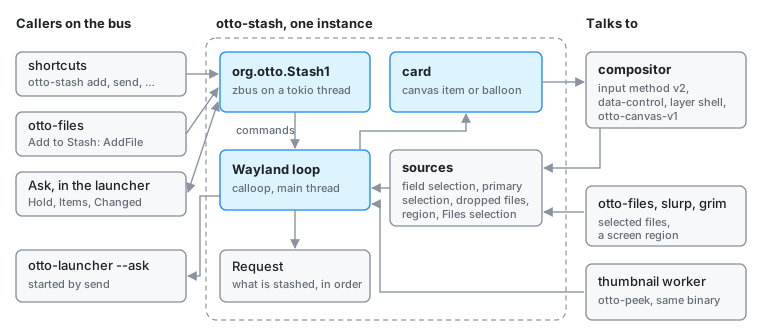
- Two threads. The main thread runs the calloop loop over the Wayland
socket. A one-worker tokio runtime serves
org.otto.Stash1and hands each call to the loop over a channel as aCommand; every change to the stash is announced back out from one task, in order, as theChangedsignal. - Where items come from.
addreads the selection in the focused field throughzwp_input_method_v2. With none there, it asks Files for the selection in the Files window that has the keyboard, and when no Files window has it, takes the primary selection. Files’ own “Add to Stash” callsAddFile.add-regionrunsslurpandgrimon a helper thread. Files dropped on the card or the invitation are taken astext/uri-list. - The card. With
otto-canvas-v1at version 3 or later the card is an item at the top of the side canvas (see Side canvas); otherwise it is a balloon on a layer-shell overlay. otto-stash never takes the keyboard, so the app in front keeps its selection and caret. - Thumbnails. File thumbnails come from
otto-peek’s thumbnailer, decoded in a sandboxed worker that is this same executable:otto_peek::run_worker_if_requested()is the first call inmain. - Handing over.
sendstartsotto-launcher --ask(or the program inOTTO_STASH_LAUNCHER). Ask, through otto-kit’s stashed-items view, callsHoldand the card steps aside until Ask leaves the bus; Ask lists the items withItems, followsChanged, canToggleorRemovean item, and callsSentwhen the request goes, which ends the stash. Items travel as file paths: text selections are written under$XDG_RUNTIME_DIR/otto-stash/. Closed without sending, Ask lets go and the card comes back.
Dependencies
- Workspace:
otto-kit(drawing, the Wayland protocol bindings, scrolling, the Stash, Files and Settings proxies throughotto_kit::dbus) andotto-peek(thumbnails). The interface itself is declared in otto-dbus (components/otto-dbus/src/stash.rs). - External:
smithay-client-toolkitandwayland-clientwith the input-method, wlr data-control and layer-shell protocols;zbus;tokio. - At run time:
slurpandgrimfor regions, and the launcher for Ask.
Going deeper
- Stash spec: the behaviour contract.
- Side canvas: the card and the drop invitation in the column.
- otto-launcher: how Ask shows what is stashed.
components/otto-stash/AGENTS.md: running a development build and the rules.