← Otto Developer Guideotto-search
User guide: Files
Specs: Search Language
otto-search is Otto’s file search, in components/otto-search/: one query
language over the desktop’s file index, so the same words find the same
files in Files, in Settings and on the command line. It turns a query into
SPARQL, asks LocalSearch (TinySPARQL) over D-Bus, and checks what comes back
against the disk. It sits in the service layer of architecture.toml: no
toolkit and no Wayland, so command-line tools and daemons can link it. It is
a library plus the otto-search command, and runs no service of its own.
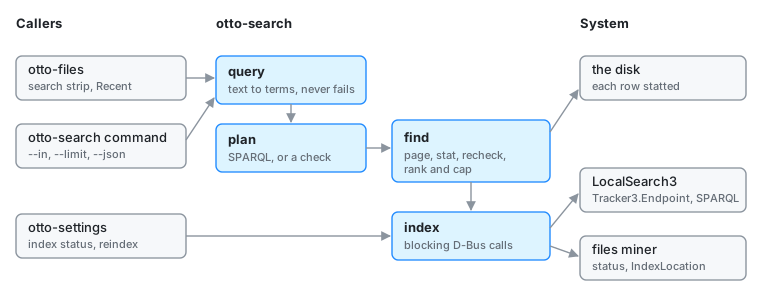
The pipeline, the SPARQL it writes, ranking, threading in Files and what happens when the index cannot answer are described in File Search. This page is the map of the crate.
Modules
| Module | What it does |
|---|---|
query.rs | parse: text into terms. It never fails: a token that does not parse stays a plain word and carries an Issue the caller can show |
plan.rs | Plan::new resolves a query against a Scope (where to look) and a Clock (what today means). The plan then renders SPARQL for the index, or admits checks a file found some other way |
find.rs | find: runs a plan to a ranked, capped list of files that are really there. It pages past rows the index remembers but the disk no longer has, stats each row, checks it again against the plan, and reports progress page by page |
index.rs | The LocalSearch wire: search, counts, status and reindex, plus file: URL conversion |
dates.rs | Calendar arithmetic for modified:, without a date crate |
main.rs | The otto-search command |
How it runs
Every call into the index is blocking: it builds a current-thread tokio runtime for one round trip on the caller’s thread, so callers run it off any UI thread. It talks to these D-Bus objects on the session bus:
org.freedesktop.LocalSearch3at/org/freedesktop/Tracker3/Endpoint, interfaceorg.freedesktop.Tracker3.Endpoint, for queries. Rows come back through a pipe the call hands over. Anything the user typed goes in as a bound parameter, never spliced into the query text.- The files miner at
/org/freedesktop/Tracker3/Miner/Files, for the indexer’s state (Missing,Stopped,Idle,Indexing,Paused) and progress. org.freedesktop.LocalSearch3.Control, forIndexLocationwhen Settings asks for the home folder to be indexed again.
The index is asked for paths and, for full-text queries, snippets. Size, modification time and kind are read from the filesystem, because the index always lags the disk a little.
Who links it
- otto-files for the search strip and Recent, with its own worker thread
and cancellation around
find. It usesPlan::admitsto merge in words read from pictures, anddateswherever it shows or groups a date. See Files and Text in Pictures. - otto-settings, whose Search pane shows the indexer’s status and file count and offers a reindex.
- The
otto-searchcommand:otto-search [--in DIR]... [--limit N] [--json] QUERY..., in the same language as the Files strip.
It depends on otto-foundations for name scoring
(matching, the scorer the launcher and the toolkit’s lists also use) and
for the index’s file: URLs, plus zbus, tokio and libc.
Going deeper
- File Search, and the search plan.
- Spec: search language. A change to the language updates the spec in the same change.
cargo test -p otto-search --test live_index -- --ignored --nocapturechecks every filter against the real index. Build and test notes: AGENTS.md.