← Otto Developer Guideotto-rdp
User guide: Remote Desktop
Specs: RDP Bridge
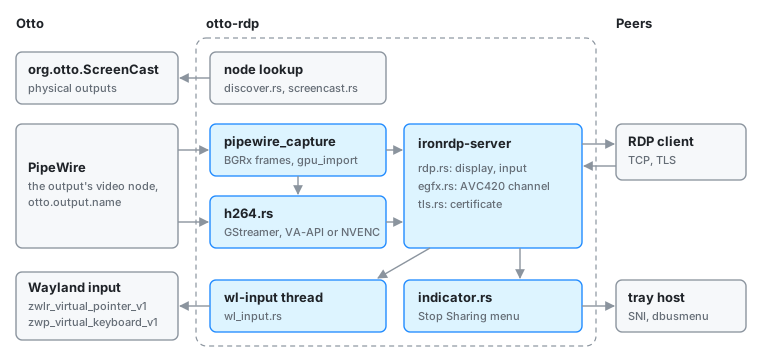
components/otto-rdp/ serves one Otto output over RDP and injects the remote
client’s mouse and keyboard back into it. It captures a virtual output’s
PipeWire stream, or a physical output through org.otto.ScreenCast, encodes
it to H.264 on the GPU (or sends bitmaps) and speaks RDP with
ironrdp-server. It is a standalone process that runs next to Otto on its
Wayland socket; the compositor does not start it and knows nothing about RDP.
It sits in the app layer of architecture.toml, and nothing depends on it.
RDP bridge for virtual outputs explains the bridge in depth: the compositor-side support it relies on, the command line, client quirks and the current limitations. This page is the structural overview.
Modules
| Module | What it does |
|---|---|
main.rs | Parses the options, resolves the PipeWire node, starts the input thread, chooses the video path and builds the RDP server |
discover.rs | Finds a virtual output’s PipeWire node by its otto.output.name property |
screencast.rs | Gets a physical output’s node from org.otto.ScreenCast: CreateSession, RecordMonitor, Start, then the stream’s PipeWireNode |
pipewire_capture.rs | PipeWire consumer for the bitmap path and for NVENC: maps shared-memory and linear dmabuf frames, repacks them as BGRx and fans them out on a broadcast channel |
gpu_import.rs | Reads back tiled dmabufs the CPU cannot map: imports them into EGL on the render node and reads them with glReadPixels |
h264.rs | The GStreamer encoder: pipewiresrc into vah264enc with VA-API, or captured frames through appsrc into nvh264enc |
egfx.rs | The EGFX graphics-pipeline driver: pushes encoded access units to the client as AVC420 frames |
rdp.rs | The ironrdp-server glue: the display handler and the input forwarder |
wl_input.rs | The Wayland client that injects input through zwlr_virtual_pointer_v1 and zwp_virtual_keyboard_v1 |
tls.rs | The self-signed certificate, generated once and kept under the XDG state directory |
indicator.rs | The tray indicator shown while a client is served, with its Stop Sharing menu |
How it runs
One process, on a multi-threaded tokio runtime, with a few dedicated threads:
- Startup. The node comes from
--node, fromorg.otto.ScreenCastfor--connector, or from PipeWire discovery by output name (defaultvirtual-1). Then thewl-inputthread connects to Otto’s Wayland socket, finds the output through xdg-output and reports its pixel size; the RDP server starts only once it knows that size. - Video, H.264 (default). The EGFX driver runs from startup. Once a client
has negotiated its desktop size and advertised AVC, a GStreamer pipeline is
built on the blocking pool. The encoder is
OTTO_RDP_H264_ENCODERif set, otherwisevah264enc, elsenvh264enc. With VA-API the pipeline reads the PipeWire node itself; NVENC is fed frames frompipewire_capture. - Video, bitmap. With
--bitmap, or when the client advertises AVC as disabled,pipewire_captureruns on its own thread and the display handler sends full-frame bitmaps that ironrdp compresses. - Input.
rdp.rsmaps RDP mouse and keyboard events back into native output pixels and sends them over a channel to thewl-inputthread, which issues virtual-pointer and virtual-keyboard requests. - Indicator. While a client is connected,
indicator.rspublishes a StatusNotifierItem on its own session-bus connection. Stop Sharing quits the whole server, not only the current client.
Who it talks to
| Peer | How |
|---|---|
| Compositor | Wayland: zwlr_virtual_pointer_v1 bound to the output, zwp_virtual_keyboard_v1, xdg-output. D-Bus: org.otto.ScreenCast for physical outputs, through the otto-dbus proxies |
| PipeWire | the output’s video node, consumed directly or by pipewiresrc |
| GStreamer | the H.264 encode graph; a hardware encoder is required for the H.264 path |
| EGL and GL | the render node, for reading back tiled dmabufs |
| RDP client | TCP, 127.0.0.1:3389 by default; TLS with a self-signed certificate unless --no-tls. There is no authentication |
| Tray host | org.kde.StatusNotifierItem and com.canonical.dbusmenu, registered with the StatusNotifierWatcher |
It links otto-dbus and otto-foundations (for xdg::state_home). GStreamer
and PipeWire are banned crates in deny.toml, and otto-rdp is one of the
listed wrappers. GStreamer raises its toolchain to Rust 1.96.
Going deeper
- RDP bridge for virtual outputs: the design, the compositor-side support, running it and its limitations.
- Remote-desktop indicator: the StatusNotifierItem and dbusmenu contract.
- Screenshare:
org.otto.ScreenCastand the PipeWire streams. - specs/rdp-bridge.md, and the user guide Remote Desktop.
- components/otto-rdp/AGENTS.md for the
environment variables,
run-rdp.sh, and the tests (cargo test -p otto-rdp,cargo test --features headless --test rdp_bridge).