← Otto Developer Guideotto-media-kit
Specs: Peek
Video playback for Otto applications, kept out of otto-kit on purpose: a media stack is more code than the toolkit it would be bolted onto, and it links GStreamer, which no application binary should.
The user-facing behaviour is specified in specs/peek.md; this page is about the pieces.
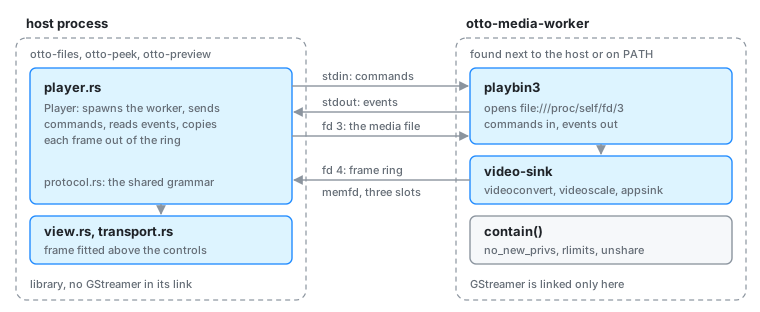
Two halves
components/otto-media-kit/
├── src/lib.rs                     the library a host embeds (no GStreamer)
│   ├── player.rs                  Player: spawn the worker, commands, events, frames
│   ├── protocol.rs                the pipe/ring contract shared by both halves
│   ├── transport.rs               the control bar: layout, draw, hit-test
│   └── view.rs                    frame fitted above the transport
├── src/bin/otto-media-worker.rs   the worker (feature `worker`, default on)
└── examples/probe.rs              play a file for 4 s with no display
Hosts depend on the library with default-features = false so GStreamer
never enters their link. The worker binary is built from the same crate and
found at run time: OTTO_MEDIA_WORKER, then next to the host’s executable,
then PATH. otto_media_kit::player::available() says whether one was found.
The worker’s contract
Descriptors are fixed, not negotiated: the media file on 3 (read-only), the
frame ring on 4 (read-write). Commands are lines on stdin, events lines on
stdout. protocol.rs has the grammar and both parsers, and its tests keep
them round-tripping.
The ring is a memfd the host creates and the worker sizes once it knows the
frame size: a 4 KiB header then three slots of tightly packed RGBx. A frame
event names the slot, the sequence number and the presentation time; the
host copies the slot out on its event thread before the worker is back to it
two frames later. ready carries the size and duration and may repeat — the
duration is often only known after preroll.
The pipeline is playbin3 (or playbin where playbin3 is missing) with
video-sink set to videoconvert ! videoscale ! capsfilter ! appsink, the
sink running sync=true max-buffers=2 drop=true. The caps filter asks for
RGBx within the host’s limits as ranges, so videoscale keeps the aspect
ratio and never scales up. The file is opened as
file:///proc/self/fd/3: the worker never learns a path.
Containment
The worker contains itself after exec (contain() in the worker binary):
chdir("/"), PR_SET_NO_NEW_PRIVS, RLIMIT_AS 8 GiB (hardware decoders map
device memory freely), RLIMIT_NOFILE 512, RLIMIT_CORE 0, then a
best-effort unshare(CLONE_NEWUSER | CLONE_NEWNET). Compared with the decode
worker in otto-peek it has no RLIMIT_FSIZE (the plugin registry
cache), no RLIMIT_CPU, a higher descriptor ceiling, and no pre-exec half.
The host clears the environment and passes a whitelist: PATH, HOME,
XDG_RUNTIME_DIR, XDG_CACHE_HOME, RUST_LOG, LANG, LANGUAGE,
PULSE_SERVER, PIPEWIRE_REMOTE, LD_LIBRARY_PATH, OTTO_MEDIA_TRACE, and
the GST_* and LIBVA_* variables, because the audio server’s socket and
the registry cache live there. Wayland and bus addresses are not passed,
but this is not a filesystem jail: with XDG_RUNTIME_DIR known, those
sockets are still reachable by path.
There is no PR_SET_PDEATHSIG. A worker whose host dies exits when stdin
reaches EOF or a write to stdout fails. Dropping a Player sends quit and
then kills the worker at once, so the worker’s own teardown rarely runs.
Debugging
OTTO_MEDIA_TRACE=1lets the worker’s stderr through and adds GStreamer’s debug string to error events.cargo run -p otto-media-kit --example probe -- FILEplays four seconds with no display, makes an accurate seek to 1 s around the two-second mark, and writes the last frame as a PNG (PROBE_PNGnames it; the default is/tmp/otto-media-probe.png). Cargo puts examples intarget/<profile>/examples/, away from the worker, so build the worker (cargo build -p otto-media-kit --bin otto-media-worker) and pointOTTO_MEDIA_WORKERat it.GST_DEBUG=3works as usual sinceGST_*is passed through.
Embedding in a preview surface
otto_media_kit::view::draw_frame draws from a Frame + State snapshot
rather than the live Player, so a host that records its drawing into a
picture on another thread (as otto-files’ preview column does) can paint the
player without holding the player. otto-files uses it in two places behind
one peek::Video: the Peek panel (autoplays) and the docked
Miller preview column (opens paused on the first frame, plays on click).
A paused pipeline emits its first frame as a preroll, not a sample, so the worker delivers both. Otherwise a paused embed would show black. The docked column always opens paused on that first frame and plays on click; only the Peek panel autoplays.
Aspect and the preview-column subsurface
The player box takes the video’s own shape, not the whole space it sits in:
otto-files’ view::preview_video_box sizes it to width / aspect + transport height, capped and centred, so a 16:9 clip in a narrow column is a
compact box on dark ground rather than a sliver in a field of black. Aspect
comes from the frame, then the announced size, then the poster
(VideoSnapshot::aspect); square pixels are already enforced worker-side, so
this never distorts anamorphic content.
In the preview column that box is its own Wayland subsurface
(pane_surfaces::sync_preview_video), so a 30 fps video repaints only that
surface — never the browser’s toplevel, nor the scene’s cached preview
picture, whose key drops the video term when the video is on a surface. Input
still belongs to the toplevel (empty input region), and the browser hit-tests
the same box, so play and scrub work through the existing routing. The Peek
panel is unaffected: it is already its own surface.