← Otto Developer Guideotto-foundations
components/otto-foundations/ holds the small rules that several Otto
programs have to agree on: where the XDG directories are, how a path becomes
a file:// URI and back, how typed text is scored against a name, how
a config or state file is replaced in one step, how a
desktop entry’s keys are read and set, what the login name is, and how a
program sets up its logging. It has no UI, no async runtime and no D-Bus.
Its dependencies are percent-encoding and, for logging,
tracing-subscriber.
It sits in the foundation layer (see Architecture Rules) and depends on no other workspace crate.
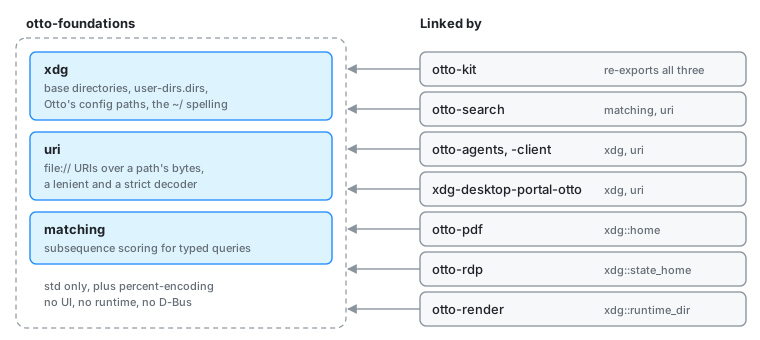
| Module | What it does |
|---|---|
xdg | The XDG base directories (config_home, data_home, state_home, cache_home, runtime_dir, data_dirs, config_dirs), home, Otto’s config paths, the user’s folders from user-dirs.dirs (user_dirs, user_dir, parse_user_dirs), and the ~/… spelling of a path (tilde, tilde_in) |
uri | file:// URIs over a path’s bytes: path_to_uri, path_to_glib_uri (the thumbnail standard’s form), uri_to_path, encode_path, and two decoders: a lenient decode_path and a strict try_decode_path |
matching | Subsequence scoring for typed queries (score, positions, word_positions), shared by the launcher, every toolkit list and file search |
fs | write_atomically: replace a file so a reader sees the old one or the new one, never half of one |
desktop_file | The [Desktop Entry] group of a desktop entry’s text: value and entries read it, with_value sets a key and keeps every other line. The greeter’s sessions, Settings’ startup and autostart entries and the portal’s program names use it |
user | The login name (login_name): $USER, then $LOGNAME |
logging | init(default_filter): tracing events to stderr, filtered by RUST_LOG when it is set and parses, else by the program’s default |
Who links it
otto-kit re-exports every module (otto_kit::xdg, otto_kit::uri,
otto_kit::matching, otto_kit::desktop_file, otto_kit::user,
otto_kit::logging, and fs::write_atomically as
otto_kit::fs::write_atomically beside the toolkit’s own file helpers), and
toolkit apps import them from there. Crates
that do not link the toolkit depend on otto-foundations directly:
otto-searchscores names withmatching, and makes and reads the index’sfile:URLs withuri.otto-agents-clientandotto-agentstake the runtime directory, the base directories andtildefromxdg, and file URIs fromuri.xdg-desktop-portal-ottofinds the Pictures folder withxdg::user_dir, hands out screenshot URIs withuri::path_to_uri, and names a screencast’s program from its desktop entry withdesktop_file.otto-agents,xdg-desktop-portal-ottoandotto-rdpset up their logging withlogging::init, as every toolkit app does throughotto_kit::logging.otto-msgredacts the login name, fromuser::login_name, in a bug report.otto-pdf(xdg::home, for~/.local/lib/otto/libpdfium.so),otto-rdp(xdg::state_home, for its TLS identity) and the compositor’sotto-render(xdg::runtime_dir, for its debug hooks) usexdg.
Before this crate existed otto-kit depended on otto-search, a crate with zbus and tokio, only for name matching. The portal and the agents crates each carried their own copies of these helpers, and the copies did not always behave the same way.
The rules
- An XDG variable is used only when it holds an absolute path. A relative
value is invalid under the spec, and an empty one is how a shell spells
“unset”. In either case the usual folder under the home folder is used.
runtime_dirhas no such fallback. It returnsNoneinstead of making up a directory that nothing cleans up. - A
user-dirs.dirsentry is$HOME,$HOME/<rest>or an absolute path. Any other value is skipped, a relative path included. desktop_filereads only the[Desktop Entry]group, so a[Desktop Action …]group’sExecis never taken for the entry’s. Of a key given twice it takes the first, and values come back as written: escapes andExecquoting are the caller’s to undo.login_nametreats an empty variable as unset, so an emptyUSERfalls through toLOGNAME.logging::initwrites to stderr, never standard output, which isotto-agents acp’s protocol stream. ARUST_LOGthat does not parse falls back to the default filter rather than logging nothing, and a second call leaves the first subscriber in place.cargo run -p otto-archkeeps these here: source rules flag a hand-rolled XDG oruser-dirs.dirslookup, a read ofUSER,LOGNAMEor a locale variable, a[Desktop Entry]loop, and atracing_subscribersetup anywhere else (the compositor’s, with its session log file, excepted).decode_pathtreats a%that is not followed by two hex digits as a literal%, because file names contain them.try_decode_pathreturnsNonefor one; use it on a wire where both ends are Otto’s. Neither decoder takes a sign as a hex digit, so%+fis not an escape.
Writing a file
fs::write_atomically(path, bytes) is how Settings writes files.toml,
agents.toml, dictation.toml, the startup list and the autostart entry,
and how Files writes files.toml and the desk’s desk.toml. Each of those
is read by another program while it may be mid-write, so:
- The bytes go to a hidden file in the same folder, made with
O_EXCLunder a name nobody can guess, then synced and renamed over the old file. A reader sees the old file or the new one. A failed write leaves the old one as it was and removes the temporary file. - A symlinked file, such as a dotfiles checkout, is written where the link points (a dangling link included), so the link survives.
- The new file keeps the old one’s permissions and, where allowed, its owner. A file that was not there gets the usual mode under the umask.
- The folder is made when it is missing, and synced after the rename.
Adding to it
A helper belongs here when a program that does not link otto-kit needs it,
and it needs only the standard library. logging is the one exception, with
tracing-subscriber, because every program has to log the same way. A
helper that draws, talks D-Bus or needs a runtime belongs somewhere else:
otto-kit, otto-dbus or the crate that uses it.