← Otto Developer Guideotto-dictate
User guide: Settings: Dictation
Specs: Dictation
otto-dictate is a proof of concept for dictating into any text field. It runs
for the whole session as the seat’s Wayland input method and waits.
otto-dictate toggle starts listening in the focused field: a balloon under
the caret shows an equaliser and the words heard so far, and when listening
stops the whole text goes into the field as one commit. It lives in
components/otto-dictate/ and sits in the app layer of
architecture.toml. Speech is recognised by a separate local speech-to-text
server, not in this process. It is not in the packages:
engines/install.sh installs it with an engine and starts it with the
session through ~/.config/autostart.
Modules
| Path | What it does |
|---|---|
src/main.rs | The input method, the toggle socket, the listening loop and the commit. |
src/balloon.rs | Draws the balloon: the equaliser on the left, settled words bright and the unsettled tail dimmed. |
engines/ | install.sh, a systemd user unit per engine, the autostart entry, and the Parakeet server source built inside whisper.cpp. See the engines README. |
The capture, the engine client, word agreement and the equaliser bars are
otto-kit’s dictation module, shared with the launcher’s dictation.
How it runs
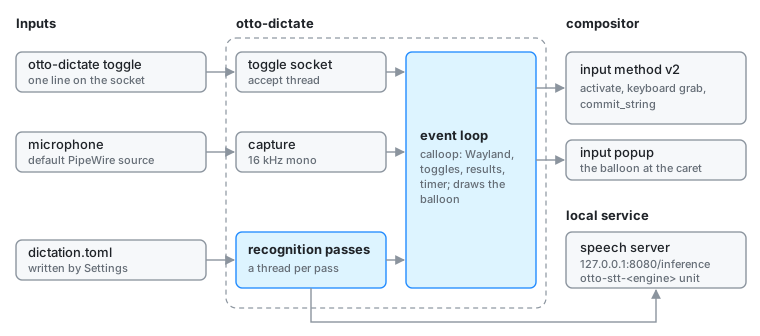
One loop. A calloop event loop on a plain wayland-client connection,
without otto-kit’s app runner. It binds zwp_input_method_manager_v2 for
the seat, wl_compositor and wl_shm, and draws the balloon in software into
shared-memory buffers at the scale the compositor prefers for the popup
(wp_fractional_scale_v1, shown 1:1 through a wp_viewport; 2x until it
says), using otto-kit’s surfaces::ScaledSurface. Three sources feed the
loop: the Wayland queue, a channel from the toggle socket, and a channel of
recognition results. A timer, faster while listening, steps the equaliser,
redraws the balloon and sends the next recognition pass when one is due.
The toggle. otto-dictate toggle connects to otto-dictate.sock in the
user’s runtime directory and writes one line. A thread accepts connections
and gives each a second to send it. There is no fallback outside the runtime
directory.
Listening. A toggle with a text field active (the input method has seen
activate) starts a dictation:
Engine::from_configreadsdictation.tomlagain, so a change in Settings applies to the next dictation.- Capture starts: 16 kHz mono from the default PipeWire source, or a WAV
file named by
OTTO_DICTATE_WAV. - The input method grabs the keyboard and opens an input popup surface, which the compositor places at the field’s text rectangle.
- Twice a second, if no pass is in flight, the buffer and the settled text so far go to the server on a thread of its own. Words two passes agree on are settled; once the buffer is long it is cut at the last settled word.
- Escape discards, Backspace drops the last settled phrase, and any other
key or a second toggle stops. Stopping sends a final pass, and its text
goes to the field in one
commit_string.
The field is never touched while listening. If it loses focus the dictation is dropped. If another input method holds the seat, otto-dictate tries to bind again a little later.
The engine. An HTTP server on http://127.0.0.1:8080/inference with
whisper.cpp’s /inference API. Three are provided, Parakeet, Whisper and
CrispASR, each a systemd user unit (otto-stt-<engine>) that conflicts with
the other two, so one runs at a time.
Settings. ~/.config/otto/dictation.toml (url, language,
hotwords_boost), written by the Dictation pane of
otto-settings, which also switches the engine units.
OTTO_DICTATE_URL, OTTO_DICTATE_LANGUAGE and OTTO_DICTATE_HOTWORDS_BOOST
override it.
Dependencies
otto-kit with its dictation feature (PipeWire capture, the ureq engine
client, agreement, bars) and Skia through otto_kit::skia for the balloon.
wayland-protocols-misc for zwp_input_method_v2, and
smithay-client-toolkit for shared memory and calloop.
Going deeper
- Spec: dictation, and the settings app spec for the Dictation pane.
- Engines README.
- Build, run and test notes: AGENTS.md.