← Otto Developer Guideotto-authorize
User guide: Privacy
otto-authorize is the session’s polkit authentication agent. When a program
asks polkit for something that needs a password (pkexec, a system service’s
action, a protected Otto setting), polkitd asks the agent registered for the
session, and otto-authorize puts up Otto’s password panel as a dialog. It
lives in components/otto-authorize/ and sits in the app layer of
architecture.toml. It runs as one process per session, started and kept
running by the compositor as otto-authorize --polkit-agent.
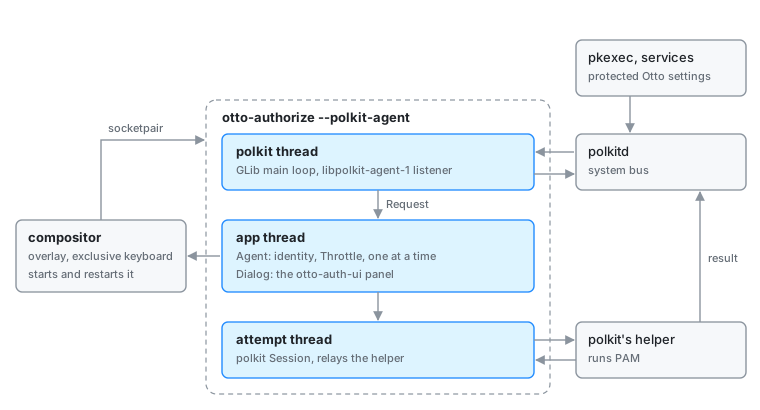
The agent never decides the answer. The password goes to polkit’s own setuid helper, which runs PAM and reports to polkitd itself. All this process can do on its own is cancel. How Otto uses polkit as a whole, including the protected settings, is on Permissions.
Modules
| Module | What it does |
|---|---|
main.rs | Checks for --polkit-agent (without it, prints a hint and exits with status 2) and starts the agent. |
polkit/mod.rs | The agent on the app thread: takes requests from the listener, picks the identity, applies the Throttle, opens one dialog at a time and answers polkitd once the dialog has a verdict. |
polkit/listener.rs | A subclass of libpolkit-agent-1’s listener (through polkit-agent-rs). Registers for the logind session and turns polkitd’s BeginAuthentication and CancelAuthentication into Requests. |
polkit/session.rs | Relays one attempt’s conversation with polkit’s helper through the library’s Session, between the helper’s signals and the dialog’s answers. |
dialog.rs | The dialog: an otto-auth-ui panel built with Panel::new_dialog on a full-screen wlr-layer-shell overlay with exclusive keyboard focus, and the conversation behind it. |
How it runs
The process has three kinds of thread.
- The polkit thread runs a GLib main loop for
libpolkit-agent-1. It registers the agent at/org/otto/PolicyKit1/AuthenticationAgentfor the session named byXDG_SESSION_ID(or the session of the process, when that is unset). If polkit already has an agent for that session, the process exits cleanly and the compositor does not start it again. Each request goes to the app thread over a channel, with a wakeup; polkitd’s reply waits on a one-shot channel. - The app thread is an otto-kit event loop. For a request it picks who to
authenticate as (the session’s own user if polkit would accept them, else
root, else the first user offered), names the program that asked from the
polkit.subject-piddetail, and shows the dialog with polkit’s message and that program’s name as the reason line. - The attempt thread is started for each attempt through
Attempt::with_conversationinotto-auth-ui. It runs the library’sSessionfor the request’s cookie, passes the helper’s prompts and messages to the panel and the typed answer back.
A request ends on a verdict: confirmed when the helper accepts, cancelled on
Escape, Cancel, polkitd’s own cancel or a minute without an answer, failed
after three wrong passwords. Another request arriving while the dialog is up
is cancelled. A program whose requests keep ending unconfirmed is held off by
the Throttle, per program and for the whole session, so nothing can keep the
panel on screen.
Who starts it
The compositor starts it at startup, outside login mode, on a socketpair
(WAYLAND_SOCKET) marked as its own component, so the dialog keeps the
keyboard against any other overlay. It restarts it with a back-off if it dies.
polkit_agent = false in the config turns it off. See src/polkit_agent.rs.
Dependencies
otto-auth-ui with its pam feature (for the panel and the conversation
types), otto-kit, smithay-client-toolkit and wayland-protocols-wlr for
the layer surface, polkit-agent-rs for polkit, tokio only for its one-shot
channel.
Going deeper
- Permissions: the auth panel and protected settings.
- otto-auth-ui for the panel.
- Testing it as the session’s own agent, and logging, are in AGENTS.md.