← Otto Developer Guideotto-agents
User guide: Ask and Agents
components/otto-agents/ is Otto’s agent service. It runs coding agents as
child processes that speak the Agent Client Protocol (ACP) on stdio, and serves
their sessions to every client over the Agent Host Protocol (AHP), so the
launcher’s Ask, the side canvas and Studio share one synchronised view of each
session. It is in the app layer of architecture.toml: nothing links it,
and clients reach it over the socket through
otto-agents-client. It runs as one long-lived
process, otto-agents serve, usually from the otto-agents.service systemd
user unit. The same binary also carries terminal commands, an ACP facade and
the chat bridge.
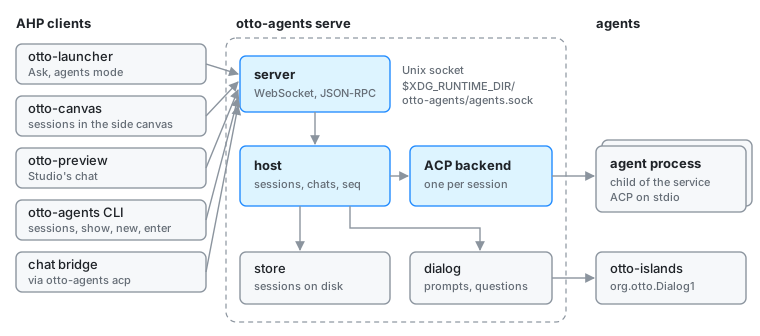
How the service works in depth (the two protocols, the launcher as a client, where permission requests and agents’ questions go, skills, configuration) is on Agents. This page is the map of the crate.
Modules
| Module | What it does |
|---|---|
server | The listener: a Unix socket (or TCP for development), WebSocket framing with one JSON-RPC message per text frame, one task per connection |
rpc | JSON-RPC framing and error shapes |
host | The authoritative state: sessions, chats, subscriptions and open questions. Every change goes through one lock, is reduced with ahp::reducers and stamped with the next serverSeq |
agent | The Backend trait the host drives through a command and an event channel, and the echo backend for tests and serve --echo |
acp | The real backend: one ACP agent per session, as a child process on stdio |
config | [[agents]] and [bridge] from /etc/otto/agents.toml, then $XDG_CONFIG_HOME/otto/agents.toml |
store | One JSON file per session in $XDG_STATE_HOME/otto-agents/sessions/, so sessions outlive a restart |
dialog | Permission and question prompts, escalated to otto-islands over org.otto.Dialog1 when no client answers |
elicitation | ACP form elicitations turned into AHP input requests |
attached | What a session’s prompts attached, and the reads of those files that need no second permission |
images | Pictures agents send, written to $XDG_CACHE_HOME/otto/agents/images so they travel as file:// URIs |
i18n | The service’s own dialog sentences, from the shared Fluent catalogues |
skills, vendors | Otto’s plugins and skills, and the plugin’s agent written in each harness’s own dialect, for plugins install |
facade | otto-agents acp: the service presented as one ACP agent on stdin and stdout |
cli | The terminal commands and bridge |
client, uri, xdg | Thin re-exports of otto-agents-client and otto-foundations |
Commands
main.rs defines the subcommands. serve (the default) runs the service; the
rest are clients of a running one, reached at OTTO_AGENTS_URL or the default
socket:
| Command | What it does |
|---|---|
serve [--echo] [--listen ADDR] | Run the service; --echo uses the built-in echo agent |
sessions, show [--follow] | List sessions, print a transcript |
new, enter | Start or take up a session in the agent’s own terminal interface. enter sends releaseSession and then replaces itself with the agent’s command |
forget | Remove stored sessions |
doctor | Check what stops Ask working, such as a missing dialog renderer |
acp | The ACP facade, for chat bridges and editors |
bridge | Replace itself with the command [bridge] in agents.toml names |
plugins install | Link the desktop’s skills into ~/.agents/skills and write the plugin’s agent for each harness |
How it runs
- One process, one tokio runtime. The server task accepts connections on
$XDG_RUNTIME_DIR/otto-agents/agents.sock. The socket’s owner-only directory is the access check; there is no authentication inside the protocol. - One child per session. The ACP backend starts the agent command
configured in
agents.tomlfor each session and talks to it on stdio. The host never talks to agents itself; it translates backend events into AHP actions. - D-Bus is outbound only. The service owns no bus name. It calls
org.otto.Dialog1on otto-islands through the otto-dbus proxy to ask the person, and a request nobody can be asked is denied. - systemd units.
otto-agents.service(off by default) runsserve, hardened withProtectSystem=strictandReadWritePaths=%h %t.otto-agents-bridge.servicerunsbridge, wants the service, and is turned on and off from Settings.
Dependencies
- Workspace:
otto-agents-client(socket, URIs),otto-dbus(the dialog proxy),otto-foundations(XDG directories). - External:
ahp,ahp-typesandahp-ws, pinned to the protocol version of the vendored spec inspec/upstream/(tests/spec_pin.rsenforces it);agent-client-protocolfor the agents;tokio,tokio-tungsteniteandzbus;fluent-bundlefor the dialog strings.
Going deeper
- Agents: the architecture and every flow in detail.
- otto-agents-client and otto-agents-kit: the client side.
components/otto-agents/README.md: commands,agents.toml, the chat bridge.docs/plans/, spec coverage and testing.components/otto-agents/AGENTS.md: build, test and the rules for the vendored spec.