← Otto Developer Guideotto-agents-client
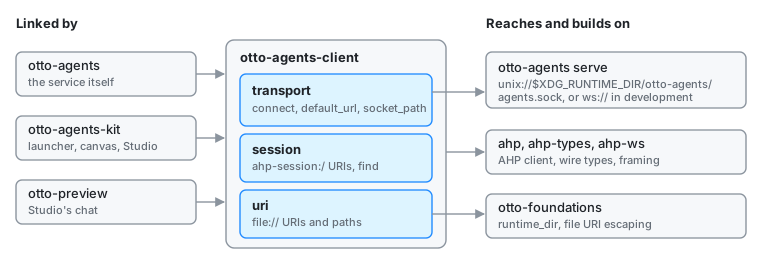
components/otto-agents-client/ holds what otto-agents and
its clients have to agree on: where the service’s socket is, how a URL names
it, how an AHP transport is opened over it, what a session URI looks like, and
how a file:// URI maps to a path. It is a small library with no process,
no UI and nothing of the service’s own logic in it. It sits in the service
layer of architecture.toml, which may use only the foundation layer and must
stay free of Skia, lay-rs and the Wayland client crates. Because it is a leaf,
the UI crates can link it without linking the service.
Modules
| Module | What it does |
|---|---|
transport | SOCKET_PATH (otto-agents/agents.sock under the runtime directory), default_socket_path, default_url, socket_path (which socket a URL names, if any) and connect, which returns an ahp::BoxedTransport |
session | SESSION_SCHEME (ahp-session:/), session_id, and find, which picks one session out of a list by full URI, id or id prefix, or the newest with no query, and says why when it cannot (NoSession) |
uri | from_path and to_path between local paths and absolute file:// URIs, with otto_foundations::uri’s escaping and its strict decoder |
lib.rs re-exports connect, default_url, runtime_dir and socket_path.
The transport
A URL is unix:///path/to/agents.sock, a bare absolute path, or ws://.
default_url is the socket in $XDG_RUNTIME_DIR (resolved by
otto_foundations::xdg::runtime_dir), and ws://127.0.0.1:4800 only when there
is no runtime directory. Clients use it unless OTTO_AGENTS_URL names
another service.
Over a Unix socket, connect runs the WebSocket handshake with
tokio-tungstenite (with localhost as the nominal host) and wraps the stream
in a private UnixWebSocket transport that frames messages the way ahp-ws
frames its TCP one: one JSON-RPC message per text frame, with pings answered
underneath. Any other URL goes to ahp_ws::WebSocketTransport. The socket’s
directory, readable only by the user, is the access check; a loopback ws://
URL is for development and tests.
to_path refuses a relative URI and a truncated or malformed escape, so a
folder means the same thing on both sides of the socket.
Who links it
- otto-agents: its
client,uriand terminal commands re-export or use these modules. - otto-agents-kit: the session feed and the Ask chat connect through it, for the launcher, the side canvas and Studio.
otto-preview(Studio), directly as well as through the kit.
It depends on otto-foundations and on ahp, ahp-types and ahp-ws, pinned
to the same version as otto-agents. Those pins are the wire between the two,
so they move together.
Going deeper
- Agents: the socket,
--listenand--url, and why there is no authentication inside the protocol. components/otto-agents-client/AGENTS.md: tests and rules.