← Otto Developer GuideFile Search
How Otto finds a file: the Files search strip, the Recent listing, the
otto-search command, and the one place all of them ask.
Behaviour is specified in specs/file-browser.md, and the query syntax in specs/search-language.md. This page describes the structure as it is built today. Text recognised in pictures is a second source of matches and has its own page, Text in Pictures.
Two layers
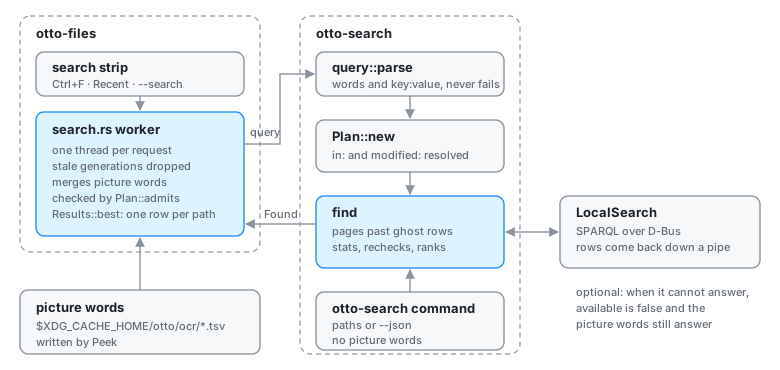
| Crate | Owns |
|---|---|
components/otto-search | The query language, SPARQL, the wire to LocalSearch, name scoring, and find: paging past rows that are gone, statting, rechecking, ranking and capping. Also the otto-search command. No toolkit, no Wayland: the agents daemon and command-line tools can link it. |
components/otto-files/src/search.rs | The worker thread and cancellation, turning results into Entrys, merging in words read from pictures. |
otto_kit::matching and otto-search both use otto_foundations::matching, so the launcher
and the command palette score with the same code.
One source, and why
Every query goes to LocalSearch (TinySPARQL) over D-Bus, and there is no second implementation behind it. A search of our own that reads every directory under home takes seconds where the index takes a fraction of one. One source is slower to be unavailable and never quietly disagrees with itself.
Otto builds no index of its own. Consulting an index the desktop already keeps, its full-text store included, is a different thing, and is what this is.
From text to rows
let query = otto_search::parse("invoice kind:pdf modified:<30d");   // never fails
let plan = Plan::new(&query, &scope, Clock::now())?;                // None: nowhere to look
let best = otto_search::find(&plan, 20, &mut ())?.best();          // Err: index unavailable
find is the whole policy for turning the index’s rows into an answer; a
caller that wants the raw rows can still call index::search(&plan.sparql(n)).
query::parsesplits on whitespace (quotes group), readskey:valuefilters and keeps each term’s byte span. A token that does not parse stays a plain word with anIssueattached.Plan::newresolves what the text leaves open:in:paths against home and the starting folder,modified:against the clock and local midnight (dates::local_offset, vialocaltime_r).Plan::sparqlrenders the SPARQL and its bindings.Plan::recheckapplies, from a stat, what the disk answers better than the index (time, size, and-kind:folder).Plan::admitschecks a file found some other way (a picture’s words) against everything buttext:.Plan::rankscores a name.find(plan, limit, progress)pages the index (below), stats every row into aFound(path, name, folder or not, symlink, size, time, snippet;Found::statis symlink-aware, and Files builds itsEntrys from it), rechecks and ranks it, and returns theResults.progressis aProgressimplementation:alive()is asked between rows, so a superseded search stops within one stat, andpage()receives the results after every page but the last.&mut ()is the no-op.
The wire
| Bus name | org.freedesktop.LocalSearch3 |
| Object | /org/freedesktop/Tracker3/Endpoint |
| Interface | org.freedesktop.Tracker3.Endpoint |
| Method | Query(sparql: s, fd: h, args: a{sv}) |
Every value that came from the person is passed in args and referenced as
~name in the query text. That is the whole injection boundary: there is no
escaping to get wrong. Values Otto computes (dates, byte counts, MIME types)
are written inline.
Rows come back down a pipe, not in the reply. index::query makes an
O_CLOEXEC pipe, hands the write end to the daemon and drains the read end on
a thread of its own, since a result set larger than the pipe buffer would
otherwise deadlock both ends. Callers are plain threads, so it builds a
current-thread tokio runtime inline to drive zbus.
The cursor’s wire format is undocumented upstream, so cursor_rows parses it
by hand: a u32 column count, one u32 value type per column, one u32 end
offset per column, then a blob of NUL-terminated strings. A truncated stream
yields the rows parsed so far rather than an error.
The SPARQL
otfl kind:pdf modified:<7d becomes, roughly:
SELECT DISTINCT ?f WHERE {
  ?f a nfo:FileDataObject ; nfo:fileName ?n ; nfo:fileLastModified ?m .
  OPTIONAL { ?f nie:interpretedAs ?c . ?c nie:mimeType ?mt }
  FILTER(STRSTARTS(STR(?f), ~root0))
  FILTER(REGEX(?n, ~word1, "i"))                       # "o.*t.*f.*l"
  FILTER(((BOUND(?mt) && ?mt = "application/pdf")))
  FILTER((?m >= "2026-09-19T10:00:00Z"^^xsd:dateTime))
} ORDER BY DESC(CONTAINS(fn:lower-case(?n), ~whole2)) DESC(?m) LIMIT 1000
What each choice is for, all measured against a home directory of 130,000 files:
- Triple patterns first, filters after,
SELECT DISTINCT. The same query with a size pattern written after a filter took a minute; this order takes a tenth of a second. REGEXfor subsequence. It costs the same as theCONTAINSit replaced, and closes the old gap where the index matchedotflby substring and missedotto-files.rs.- Order by “contains each word outright”, then newest. Subsequence matches are broad; ordering like this keeps the cap from cutting a real match in favour of a newer scattered one.
- The MIME type is
OPTIONAL. LocalSearch recordsnie:interpretedAsonly for files it has an extractor for. Archives, scripts and most source files have none, so a required type silently drops them. Tests on?mtand?care guarded withBOUND, so a negated kind keeps them. kind:archiveis by extension, since no extractor gives archives a type.kind:documentandkind:appare membership of the index’sDocumentsandSoftwaregraphs.-kind:folderis not sent at all. Folders always carryinode/directory, but joining the type onto every row doubled Recent’s cost, andNOT EXISTSon a folder type took over twenty seconds. The stat that every row gets anyway answers it (Plan::recheck).text:is?c fts:match ~text, each term an FTS5 quoted string so typed operators are matched as words, withfts:snippetmarking the hit betweenU+0002andU+0003.index::Snippetturns that into text and byte ranges. A negatedtext:is aNOT EXISTSwith its own match; it is the slowest shape (a few seconds over all of home).
The live test runs every shape against the real daemon and fails any that takes over five seconds.
A request
Request carries the query text, the default roots, the folder a relative
in: is relative to, and a debounce.
| Constructor | Query | Roots | cwd |
|---|---|---|---|
Request::recent() | -kind:folder sort:modified | recent_roots() | none |
Request::folder(q, dir) | q | [dir] | dir |
Request::everywhere(q) | q | [home] | none |
recent_roots() is the XDG user directories that exist, less Recent itself
and less $HOME, falling back to $HOME when there are none. Home’s most
recently written files are caches, dot directories and build output.
The debounce is Duration::ZERO at every call site. A search runs when
Return is pressed, not on each keystroke, so there is no burst to wait out;
the field is kept as a seam for a caller that needs one.
Ranking
Scoring is otto_foundations::matching::score, shared with the launcher. It matches
by subsequence, not edit distance: +8 for a matched character, +14 at a
word boundary, +20 at the start, +12 for staying adjacent, −1 per skipped
character up to ten, and a length penalty of −len/6 at the end.
Plan::rank scores each word of the query on its own and adds the scores, so
tax invoice finds invoice-tax.pdf; a phrase must appear as written, and an
excluded word must not appear.
What decides which results survive the cap depends on sort:: the name score
for relevance and for A to Z (the pane then sorts by name), the modification
time for sort:modified and for a query with no words (Recent), the size for
sort:size. A file whose time or size cannot be read sorts to the bottom
rather than disappearing.
Results holds the winners: it collects to twice the limit, then sorts and
truncates, so a thousand results cost one sort rather than a thousand
insertions. Files’ LIMIT is 500; the command’s default is 20.
Results::best deduplicates by path, so a picture found by both its name and
its recognised words is one row, and puts sort:name results A to Z. Files
pushes its pictures into the same Results before taking the best.
Ghost rows
The index can remember files the disk no longer has. On the machine this was
written on, a deleted browser profile under ~/Desktop left over 900 of the
1000 newest rows under Recent’s roots pointing at nothing. Those rows are
dropped when the stat fails, and find goes back for more. The first page is
twice the limit, and at least MIN_PAGE (200) rows so a small limit still
ranks from enough candidates; each next page is four times larger (a round
trip costs the index’s sort of every match, not the rows returned), up to
MAX_PAGES asks, stopping once the limit’s worth of real files are in hand or
the index runs out. Files sends the results so far, not done, between pages.
A later page that fails ends the search with what the earlier ones found.
Threading and cancellation
Search mirrors the contract model::Directory already has: start never
blocks and poll never blocks.
start makes a fresh channel, bumps a shared generation counter and spawns the
worker thread. The worker’s Sink holds the counter and the generation it was
born with; alive() compares them, and a superseded request’s batches are
never sent. Nothing is interrupted — a stale worker finishes and its answer
is dropped. Dropping the Search bumps the counter too, so closing a pane stops
its worker.
After a successful send the sink calls AppContext::request_wakeup(). An idle
window commits no frames, so without it the batch would sit in the channel
until the next key or click.
poll drains the queue and returns the last batch only: a batch replaces
the results, it never appends, because the worker has already ranked and
capped. A request sends one batch per page read, the last with done set.
When the index cannot answer
Every failure path fails before the first send, so a failure can never land on
half an answer. The reason is logged, and the batch goes out with available
false and whatever the OCR cache found.
That flag reaches the window. The status line reads File indexing is off
(files-search-unavailable) rather than Nothing found, and the empty pane
says the same. Nothing found and nothing able to look must not look alike.
LocalSearch is an optional dependency (optdepends in the PKGBUILD), so a
fresh install may have no indexer at all.
Its systemd unit carries ConditionEnvironment=XDG_SESSION_CLASS=user and
silently declines to start without it. When Otto owns the session it exports
that variable with systemctl --user set-environment and
dbus-update-activation-environment, alongside WAYLAND_DISPLAY
(src/state/mod.rs, udev backend only). A missing assignment takes file search
down with it.
Text in pictures
ocrcache::matches is the second source. It scans every .tsv in
$XDG_CACHE_HOME/otto/ocr/, matching a needle as a lowercase substring of the
words, and skips an entry whose picture has been modified since it was read.
ask_pictures asks it for every text: term, or for every plain word when
the query has no text:, and keeps the pictures that match them all. It stats
them into entries, checks them with Plan::admits (admits_ignoring_names
when the words stood in for the name) and ranks them at i32::MAX, as high as
a name match can reach. It runs on both paths, so recognised words answer
even with the indexer off. See Text in Pictures for what
fills the cache.
Recent
Recent is the query -kind:folder sort:modified, and a different sentinel path:
/dev/null/otto-recent, against search’s /dev/null/otto-search. They must
differ because the sidebar lights the place whose path matches the pane’s, and
one shared sentinel lit Recent as soon as anyone typed a query.
recent.rs buckets the results by day (Today, Yesterday, This Week, This
Month, Earlier) cut at local midnight through localtime_r. Entering Recent
forces the grid and a descending sort by modification time, and pins the sort
control off.
Both Recent and a result set are synthetic panes: Column::synthetic gives
them an idle loader, a dead DirWatch (inotify declines the sentinel) and
epoch = 0, so the view can tell “still filling” from “empty”. Results are
deliberately unwatched. A file appearing three levels down must not reshuffle
the list while it is being read.
Selection in a synthetic pane is keyed by path rather than name, so three
Cargo.tomls in one result set select one at a time.
Anything that needs a folder behind it refuses on these panes with
files-synthetic-no-action, and results can be shown as a list or a grid but
never as Miller columns (files-search-no-columns).
The strip
app/searching.rs is the controller and view.rs draws it.
- Ctrl+F opens the strip, records where you were and what it was called, and focuses the field. Pressed again while the field has focus it closes; pressed while the strip is up but blurred it takes the focus back and selects all.
- Return runs the query. Typing does not: the only thing a changed field does by itself is treat an emptied field as a cancel and navigate back to where the search began.
- Up, Down, Page Up, Page Down, Tab hand the keyboard to the listing with the strip still up. Escape clears.
- The two pills switch between This folder and Everywhere, re-running the query against the other haystack.
The field is deliberately leaky: it takes the editing keys and the keys that belong to a search, and lets every other chord through to the window. Escape unwinds in a fixed order: info panel, Peek selection, search, Peek, filter menu, picker, selection.
A plain printable key in the listing is type-ahead, not search: a one-second
prefix match that moves the cursor and filters nothing (app/cursor.rs).
Running a search replaces the pane with the results, forces the grid if the view was Miller columns, and records a history entry, but only for the first query, so refining does not stack up entries to walk back through. Going back to a search re-runs it rather than restoring stored rows.
The strip shifts everything below the header, and two dozen geometry helpers
take an area rather than a browser, so its height lives in a process-global
atomic (view::set_search_band / search_band_h) that the scene cache key
includes. The magnifier is drawn by hand, a circle and a stub, so it cannot go
missing on a sparse icon theme.
The command
otto-search [--in DIR]... [--limit N] [--json] QUERY... is the crate’s
binary (src/main.rs). The words are joined into one query; --in sets the
default roots (home otherwise), and a relative in: in the query is relative
to the current directory. It prints one path per line, or with --json one
object per line, Found::to_json: path, name, kind (file or
folder), modified (RFC 3339, local time), size (null for a folder) and
snippet. Parse issues go to stderr as hint: lines. Exit status: 0 found,
1 nothing found, 2 index unavailable, 3 usage error.
The command does not read Files’ OCR cache, so words read from pictures answer in Files but not here.
Opening Files on a search
launch.rs reads the browser’s arguments: parse takes the words, resolve
decides against a probe of the disk (both are pure, and tested that way).
otto-files --search QUERY [--in DIR]opens on the results:Browser::start_searchis Ctrl+F where the window opened (DIR, or home for Everywhere), the query typed and Return pressed, so Escape and Back lead back there.otto-files --select PATH..., or a file as a plain argument, opens the first path’s folder with every given path in that folder selected.- With both, the selection waits for its row in the results.
The selection is held in Browser::pending_select as selection keys and
settled each frame by settle_select: a folder settles when its read lands,
results as soon as every path has arrived or when the search ends with at
least one of them. Settling a selection in results hands the keyboard from
the query to the listing. Missing paths and unknown options are warnings on
stderr; the window then opens at home.
Beyond the window
- The in-app command palette has Search and Recent in its Go group. A query given as the command’s argument is a Return already pressed.
- otto-launcher does not search files yet. It shares only
otto_foundations::matching::scorewith otto-files. - otto-files exports no search interface over D-Bus. Its only interface is
org.otto.FilePicker1, which the portal brokers, and the picker has no Find strip.
Testing
cargo test -p otto-search                     # parser, SPARQL, wire, scorer, results, the command's arguments
cargo test -p otto-files --lib search         # the provider and the strip
cargo test -p otto-files --lib launch         # the browser's arguments
cargo test -p otto-search --test live_index -- --ignored --nocapture
cargo test -p otto-files --lib live_index -- --ignored --nocapture
The unit tests never touch the bus: the unavailable-index test passes empty
roots so the query is refused before a connection is made. The two live_index
commands do, and need a running indexer: the first runs every query shape
against it with a time budget, the second the whole worker.
Strings live under files-search-* and files-recent-* in
resources/locales/en-GB.ftl.