← Otto Developer GuideDRM Planes and Direct Scanout
How Otto hands parts of the screen straight to the display hardware, so the GPU does not have to composite them.
Structure and rationale live here. The full behavioural contract (per-buffer damage rules, blur-composite invalidation, promotion hysteresis) is
specs/plane-scanout.md.
Reparenting a layer raises it
add_sublayer on a layer that is already a child moves it to the end of its
parent’s children, which is exactly how raise_window_to_front raises a
window. Anything that reparents a window layer therefore raises it as a side
effect, whatever its place in the stack was.
Promotion moves a window’s subtree out of the workspace’s windows_layer and
into the output’s promoted-plane container; demotion moves it back. That move
back is a raise, so a window demoted after another one was mapped would come
back on top of it. The workspace’s windows_list is the stack, and
WorkspaceView::restack_windows re-applies it after every demotion.
The promoted plane also scans out above the windows plane, so anything left
promoted while it is no longer the topmost window covers the window that is.
Promotion waits for its candidate to settle (PROMOTE_STABLE) to avoid moving
a live subtree between containers every frame; demotion must not wait, or a
newly mapped window comes up behind the one it should be covering.
What a plane is, and why you would want one
A display controller can read from more than one buffer and blend the results itself, on the way to the cable. Each of those inputs is a plane: one primary plane (always present), zero or more overlay planes, and usually a dedicated cursor plane.
The analogy is a physical animation cel stack. Instead of repainting one sheet every frame, you draw the background once, the characters on a second sheet, and the caption on a third — then let the camera stack them. Moving the caption means moving one sheet, not repainting the picture.
Concretely: the app switcher is on its own plane, so while it is animating the GPU renders a small strip and the display engine composites it over untouched buffers. The background, the windows and everything else are not touched at all, and often no GPU work happens for that frame whatsoever.
What Otto actually does
Most compositors use planes opportunistically: “if a fullscreen window happens to be scanout-compatible, promote it”. Otto goes further and deliberately splits its own scene into per-purpose buffers so there is something for the planes to take.
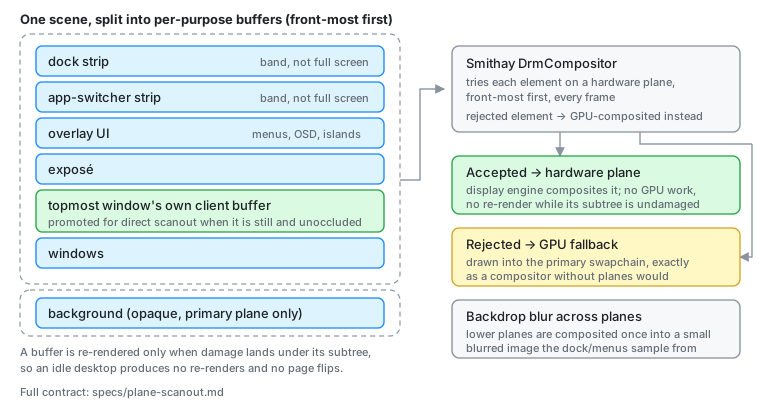
For the same decomposition seen from the other end (which scene subtree each of these buffers is rendered from), see the overview in The Scene Graph.
Per output, front to back: the app-switcher strip, overlay UI (the bar, the
islands, the dock, the OSD and popups), exposé, the promoted client window,
the windows buffer, and the background. Each of those is a subtree of the
lay-rs scene. See The Scene Graph for how the tree is
shaped and why.
(When the session is locked, only the lock plane is composited: nothing that
could hold a window is even consulted.)
Two details are load-bearing:
- The switcher buffer is a strip, not a full screen. It starts as a
centred band of
min(height/2, 960)px and follows its content from there (fit_plane). A small buffer means a switcher animation redraws a band rather than a screen, and KMS bandwidth (“watermark”) cost scales with plane size. The dock has no plane of its own: a plane costs the full pixel rate whatever its size, so the dock draws on the overlay plane with the rest of the chrome and leaves the spare plane to a client. - The background is
XRGB8888and opaque, and is pinned to the primary plane (Kind::Unspecified). A full-output opaque buffer that floated up to an overlay would hide every element that had fallen back to GPU compositing in the primary swapchain.
The rest are ARGB8888 and non-opaque, since they have to blend.
A buffer is re-rendered only when damage lands under its subtree. An idle desktop produces no re-renders and no page flips.
When decomposition is enabled
SurfaceData::planes_enabled (src/udev/device.rs) requires all three:
- An atomic driver. Legacy KMS cannot do per-frame plane assignment.
- At least 3 overlay planes. Fewer than that and the buffers cost GPU memory for nothing.
- The primary GPU. Plane dmabufs are rendered with the primary GPU’s EGL context; a cross-device import per plane per frame is not reliable.
When any fails, the output renders as a single scene element (the ordinary
path), and Otto logs why under the otto::planes target.
NVIDIA: overlay planes are cleared entirely at surface creation, because overlay usage on those drivers is broken. That also disables decomposition, by way of the overlay count check.
How assignment actually happens
Otto does not assign planes. It hands Smithay’s DrmCompositor a list of
render elements, and render_frame() tries each one on a plane, front-most
first, every frame. For each element it:
- Calls
element.underlying_storage(renderer).Nonemeans the element has no importable buffer and must be GPU-composited. - Exports a dmabuf and adds a framebuffer via the framebuffer exporter.
- Tests plane compatibility (format, transform, z-order, size) with
try_assign_plane(). - Assigns it if compatible; otherwise the element is rendered by the GPU into the primary swapchain, exactly as a plane-less compositor would.
So plane usage is best-effort and re-decided per frame. There is no probing step and no cached tier: acceptance is delegated to the kernel, and rejection is a normal, silent fallback.
For an element to be eligible for an overlay it must provide
underlying_storage(), report Kind::ScanoutCandidate, be backed by a dmabuf
(not CPU memory or an anonymous GPU texture), and use a format and transform
the plane supports. Kind::Unspecified leaves an element to the primary plane,
which is how the background stays pinned there.
Direct scanout of a client window
The topmost window can be promoted: its own client buffer goes straight to a plane, so its pixels never pass through Otto’s renderer at all. This is the big win for video players and games.
Promotion has hysteresis: the candidate set must stay unchanged for 500 ms
(PROMOTE_STABLE) before anything new is promoted, because flapping between
promoted and composited is visible as a flicker. Only the root surface is
promoted: the shadow and the server-side decorations keep rendering in the
windows buffer.
Otto also publishes dmabuf feedback to clients, with a scanout tranche
alongside the render tranche, so a client can allocate buffers in formats that
are promotable in the first place (get_surface_dmabuf_feedback in
src/udev/feedback.rs).
The blur problem
Planes composite in the display engine, which means a translucent plane cannot see the planes below it — but Otto’s dock, menus and OSD are frosted glass and must show what is behind them.
Otto solves this by compositing the lower planes into a separate, downscaled
image, blurring it once as a whole, and letting each blur-bearing layer seed
itself from that pre-blurred image (src/udev/backdrop.rs). Blurring once per
frame rather than once per consumer is both cheaper and more correct:
blurring inside a layer’s rounded clip samples transparent pixels at the shape
edge and leaves a faded rim, while a whole-image blur has no edge to sample
across.
Promoted client windows are folded into that composite by blitting their dmabuf (the same buffer KMS scans out), so a shared window does not vanish from the blur behind the dock.
The composite is rebuilt only when lower-plane damage lands under a blur
consumer. A consumer is the set of BackgroundBlur shapes in a plane’s
subtree (the dock bar, a hovered label, the switcher card), each outset by
BLUR_REACH, not the plane’s whole strip; SceneDmabufElement:: subtree_blur_rects reads them from lay-rs’ bubbled-up backdrop_blur_region.
Damage that misses every consumer rebuilds nothing and marks nothing, but is
remembered (SurfaceData::backdrop_missed_damage): when the consumer set
changes and the new set covers remembered damage, the composite rebuilds at
once, bypassing the desktop rate limit. Both rules are unit-tested at the
bottom of backdrop.rs; in debug-hooks builds, touch /tmp/otto-perfdbg
logs the per-frame decision with its interest and missed rects.
Debugging
# What Otto decided, per output
RUST_LOG=otto::planes=info cargo run -- --tty-udev

# What Smithay decided, per element per frame
RUST_LOG=smithay::backend::drm::compositor=trace cargo run -- --tty-udev
Useful trace lines:
assigned element … to overlay plane …: successskipping element … element kind not scanout-candidate: wrongKindskipping direct scan-out … format … not supported: format mismatchfailed to claim plane: the plane is already in use
Build with --features debug-kms for extra KMS logging.
Related
specs/plane-scanout.md: the contract- Rendering: the pipeline these buffers feed
- Render Loop: the damage rules that decide what re-renders
src/udev/planes.rs,src/udev/backdrop.rs,src/udev/render.rs